A Renaissance treasure, buried in a forest
Cellini’s golden salt cellar left a Vienna museum through scaffolding. Almost three years later, investigators found it underground.
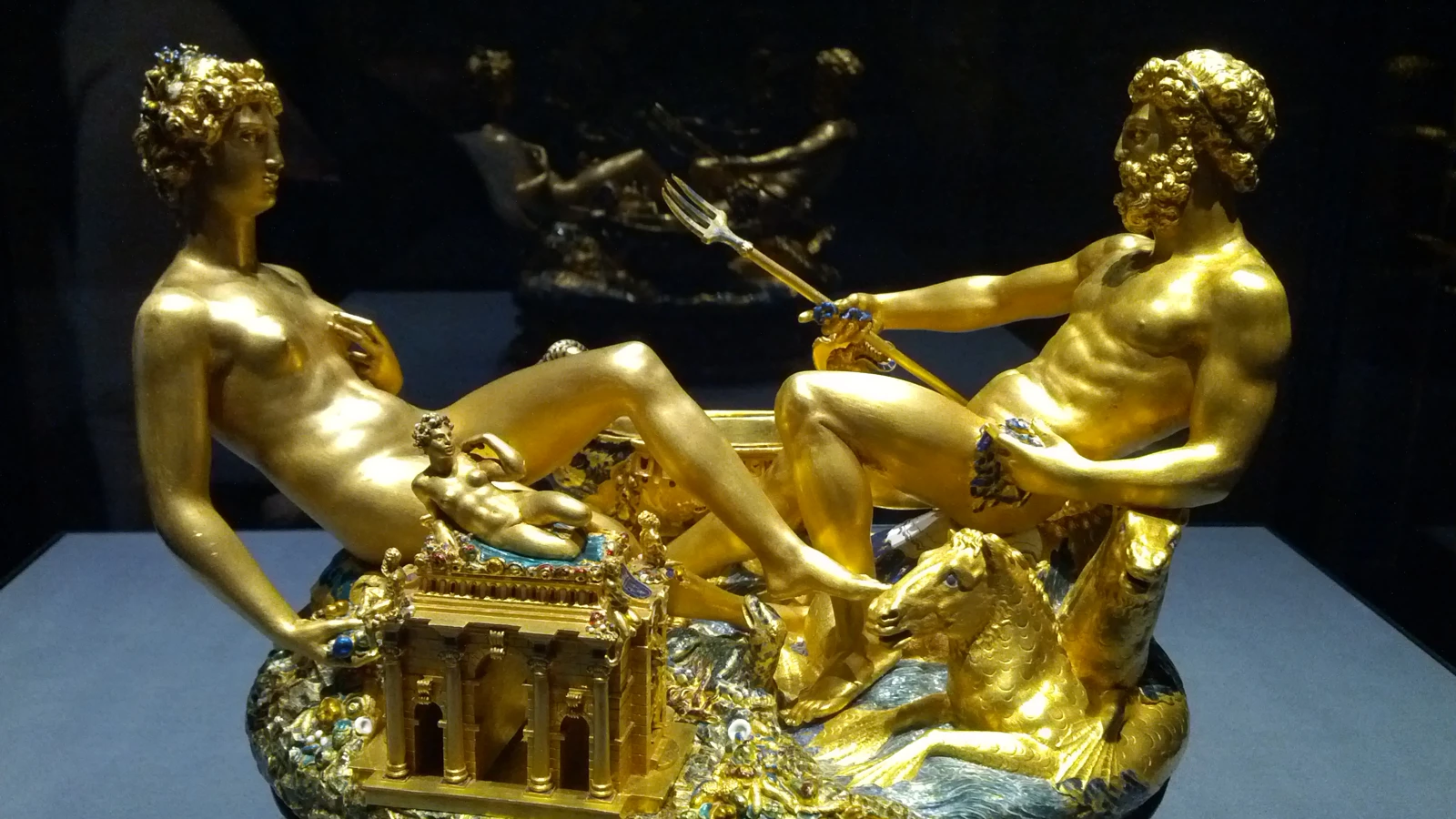
Scaffolding outside, a treasure inside
During the night of 10–11 May 2003, Benvenuto Cellini’s Saliera was stolen from Vienna’s Kunsthistorisches Museum. The museum’s initial announcement described access via exterior scaffolding, a broken window and a smashed display case. Alarms had been triggered. The question was how the intrusion had progressed despite them, not whether the building had any alarm at all. [1]
An object that could not simply disappear
The Saliera is a Renaissance goldsmith’s work, its sculptural figures making a salt cellar into something far more ambitious than a table accessory. Its loss posed a different problem from a stolen painting: this was an unmistakable three-dimensional object. Austria’s Interior Ministry records a demand for five million euros and an investigation lasting almost three years. [1][2]
The forest ending
In January 2006, investigators recovered the work from a metal container buried in Lower Austria’s Waldviertel region. ORF’s retrospective describes the frozen ground and the subsequent examination in Vienna. The museum announced its return and plans for public display. Early conservation findings included scratches and small enamel losses, a reminder that recovery and perfect preservation are different outcomes. Official and broadcast retrospectives differ by a day on the find; the month, location and return are the secure points of agreement. [2][3][4]
Recovered
Recovered in January 2006 and returned to the Kunsthistorisches Museum. Initial examination recorded scratches and small enamel losses. Accounts disagree on the exact recovery day, so this chronology uses the month.
Sources checked 8 November 2026.Artwork Details & DocumentationIdentification, ownership history and supporting records
Individual artwork identification details have not yet been documented in this record. Missing specifications are not inferred from the photograph or report headline.
Not documented in this record: object type · materials & technique · measurements · inscriptions & markings · distinguishing features · artwork title · maker / attribution · creation date / period · subject.
Record sources
Identification details follow the Object ID categories where documented. Ownership history is recorded separately; this documentation is not an authentication or a certificate of ownership.
Sources & further reading
- Kunsthistorisches Museum · Theft announcement, May 2003 ↗
- Austrian Ministry of the Interior · Recovery retrospective ↗
- Kunsthistorisches Museum · Return announcement, January 2006 ↗
- ORF · Twenty years after the recovery ↗
An original narrative synthesis of the sources above. Images depict the artworks; they are not reconstructions of the thefts.